Before You Work Harder Again, Recalibrate Instead.
Consider the Easier Solution: A Feldenkrais® Reset for the Rider
What if improvement did not have to mean more effort, more repetition, more correction and more trying?
Imagine this:
You get on your horse and something simply feels different. In a good way — almost like finding a saddle that both you and your horse prefer.
Your leg hangs more easily.
Your pelvis moves more freely.
Your back feels longer.
Your balance is quieter.
Your aids become clearer.
You are not holding yourself together or constantly reminding yourself what to fix.
Things that used to require effort begin to feel easier — and what feels easier begins to look and feel more beautiful.
As Dr. Moshe Feldenkrais said:
“To make the impossible possible, the possible easy and the easy beautiful.”
Many riders have been taught that improvement comes from repetition:
Do it again. Do it more. Work harder until the new habit finally sticks.
But what if your nervous system simply has not yet discovered a better option?
Feldenkrais takes a different approach — creating meaningful change through ease rather than more strain, force or endless repetition.
Instead of drilling the same movement thousands of times, we use slow movement, sensation, attention and carefully chosen variations to give your nervous system new information.
In Riding, Sensitivity Is Everything.
Yet the harder we grip, brace and hold, the harder it can become to feel the subtle information we actually need in order to change.
Think of it as turning down the muscular “volume.”
Less noise gives you the opportunity to notice more.
And your nervous system is remarkably intelligent: it notices differences, compares possibilities, and can discover a better solution — sometimes almost spontaneously.
A reset.
What becomes possible when your nervous system learns what it no longer needs to do?
✓ Less gripping
✓ Less bracing
✓ Less unnecessary muscle contraction
✓ Less effort spent holding up a posture artificially
And in their place?
A more mechanically efficient, softer and more sustainable way to ride — one that feels better to you and very often feels better to your horse, too.
What If You’re Already Doing All the “Right” Things?
You may already stretch, strengthen, do Pilates or yoga, get bodywork, chiropractic care or PT.
Feldenkrais is different.
It does not ask you to work harder or force a better position. It helps your nervous system discover easier, more efficient ways to organize your whole body for riding.
That is the reset.
And that is what Fall Wheel Alignment is designed to help you experience.
Fall is a natural time to go inward, regroup and reorganize.
Fall Wheel Alignment gives you a carefully sequenced, whole-body reset you can do comfortably at home.
Just six 45-minute lessons, taken in order, create a carefully structured rider reset.
Riders at every level have benefited from this kind of work — from Olympians and national-team riders to adult amateurs rebuilding confidence, coordination and ease.
Fall Wheel Alignment
October Special: $299
Regularly $379
✓ 6 lessons — approximately 45 minutes each
✓ Designed specifically for riders
✓ Taken in sequence to progressively reorganize the whole body
✓ Lifetime access — work at your own pace
✓ Used from adult amateurs to national-team riders and Olympians
$299
A Foundational Reboot for the Rider
Riders at every level have benefited from this exact work — from Olympians and national-team riders to adult amateurs rebuilding confidence, coordination and ease.
This material is carefully thought out to emulate working with Dave one-on-one, using a deliberate progression rather than isolated exercises.
Dave works privately with some of the world’s best riders. If you came to him and asked for Feldenkrais® lessons chosen specifically to help your riding improve — sometimes through surprisingly indirect routes — there is a very good chance he would select some of these same lessons.
Why?
Because while every rider is individual, we also share fundamental human movement patterns and developmental blueprints.
Sometimes improving the way your foot senses the ground changes what happens in your hip.
Sometimes reorganizing the ribs changes the freedom of the pelvis.
Sometimes the route to better riding is not where you expect it to be.
That is part of the genius of the sequencing.
These lessons address patterns that are deeply shared across human movement, and Dave has seen them produce reliable changes in riders at many different levels.
You can benefit from that same process, too.
✓ A 360° approach designed to leave you feeling better, riding better, and overall moving and looking better
✓ Become more symmetrical, balanced and supple, with greater ease doing what you want on both sides
✓ Foundational work that addresses the rider as a whole — not just individual body parts
✓ The material works with your nervous system in a chronological way: functional, developmental and evolutionary
✓ Each lesson builds on the one before it, helping prepare your nervous system for the next step
✓ This unique sequencing is what helps fuel the reset
This is not another exercise course.
It is a carefully constructed process designed to help your nervous system discover better options for movement — and bring those options back to your horse.
A course unlike any previous DTM program.
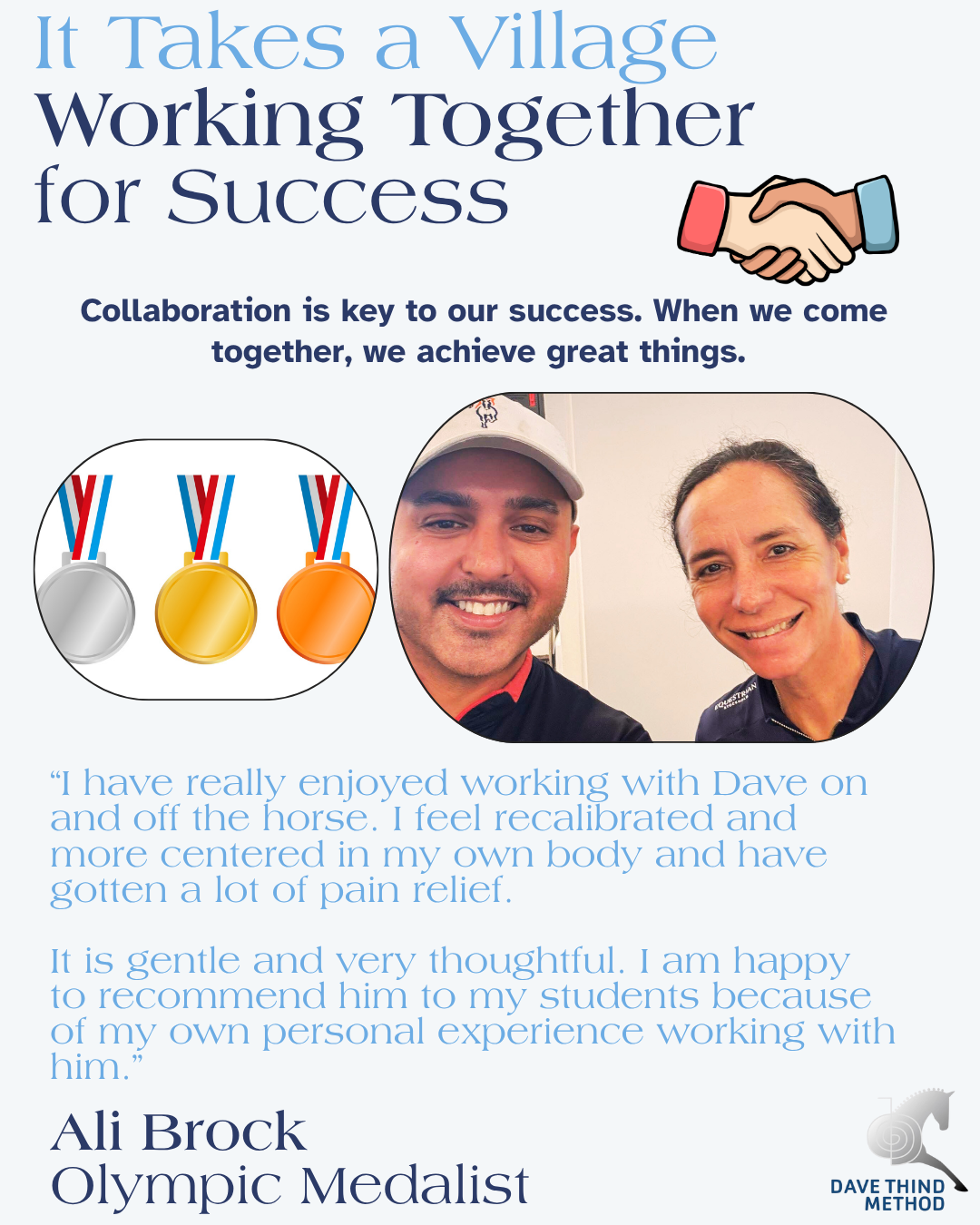
Even the World’s Elite Riders Continue to Work on Their Seat
This self-work is for self-care and self-improvement, but also for their craft — to be able to better feel, supple and train their horses.
They know this work is crucial, exciting and rewarding — which is why Dave works with some of the best riders on both sides of the Atlantic.
Recalibrated. Centered. Gentle. Thoughtful.
Those are some of the words riders have used to describe this work.
And in Ali Brock’s case, a lot of pain relief.
Pain relief is not the primary promise of this course — but it is one of the reasons so many people around the world are drawn to the Feldenkrais Method.
Pain among riders is far more common than many realize. Research cited by Eurodressage reported that 74% of riders surveyed at a four-star competition were competing with chronic pain, while 85.4% of non-elite riders over 35 reported experiencing pain.
So if you are carrying old stiffness, discomfort, or compensations into the saddle, you are certainly not alone.
This is not only about the rider.
A rider who is bracing, protecting pain, asymmetrical, or unable to move freely changes what the horse feels underneath them.
Your comfort and organization in the saddle are part of your horse’s welfare, too.
When the rider can move with less pain, less unnecessary tension and more adaptability, the horse has a better chance to move freely, stay balanced, and respond to clearer, softer aids.
By reducing unnecessary effort, improving awareness, and helping the nervous system discover more comfortable and efficient ways to move, many people report meaningful reductions in pain, stiffness and chronic discomfort.
Sometimes the change is not about “fixing” the painful area at all — it is about changing the way the whole person organizes around it.
That can be especially powerful for riders who have spent years compensating for old injuries, stiffness, asymmetry or familiar patterns of tension.
More on this particular course
Whether we call it a “wheel alignment,” “reboot,” “recalibration,” or even a “rider makeover,” these specific DTM Feldenkrais® Awareness Through Movement® lessons are designed to do just that — and more.
Sometimes our bodies seem to work against us, and unless something changes, these struggles don’t simply disappear. Often they intensify, stealing away some of the pleasure of your ride and disrupting the harmonious connection with your horse.
What riders are looking for is often surprisingly simple:
To feel more centered.
To feel more recalibrated.
To move with less effort and more ease.
To experience change in a way that is gentle and thoughtful.
And, for some, to find meaningful relief from pain and discomfort.
Whether you are a professional or amateur, we all have dreams and goals — including better performance while meeting classical objectives such as improved biomechanics, greater harmony, and enhanced communication with our horses.
This course is designed to help you move closer to those dreams and goals.
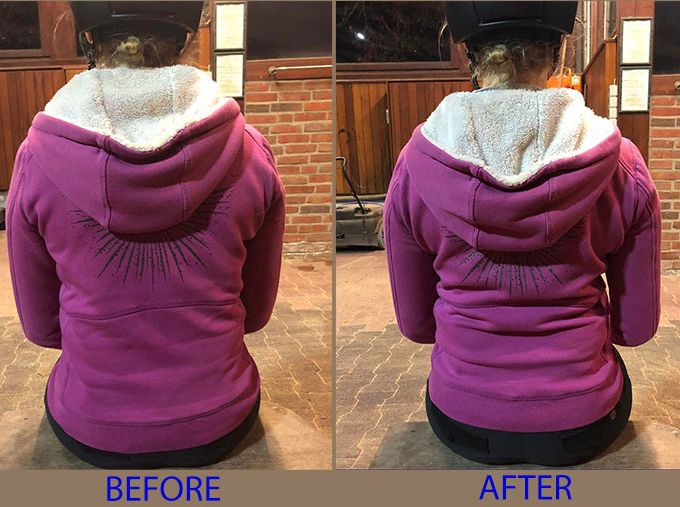
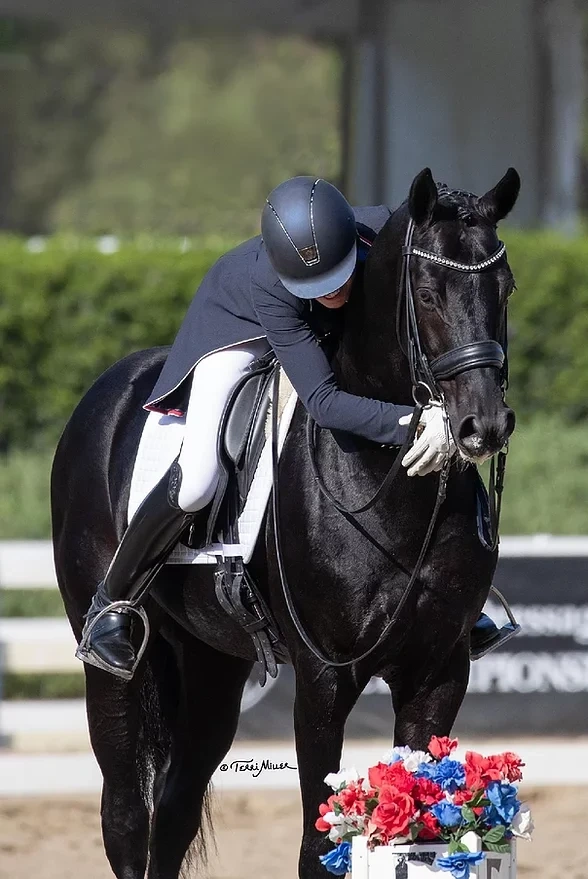

Our Curriculum for This Rider Makeover Is Below — But First, Imagine This…
Your movements flow more effortlessly.
Your seat feels secure, supple and completely in sync with your horse.
Your body feels capable, strong and natural — able to absorb the forces of each stride with greater ease instead of bracing against them.
You feel more balanced.
More coordinated.
More available to your horse.
And instead of constantly correcting yourself, you are simply riding.
You are not just working toward better riding — you are experiencing it.
The kind that feels good.
The kind that looks harmonious.
The kind your horse can respond to.
You may even find yourself exceeding goals that once felt difficult or out of reach.
Sounds like a dream?
It doesn’t have to be.

Lesson 1:
Improvement toe to head. Yes toes! 🦶
We will begin this series and illuminate your toes in your mind's eye, providing better support, comfort, stability and "inexplicable" improvement and changes from the ground up. Your feet and everything above will function better.
From a top GP rider after doing this same, privately online just last week: "My hips feel super, I'm sitting much better and I'm riding so much better. So great! It helped so much I can't even describe! You know Feldenkrais, not describable."

Lesson 2:
We will clarify and improve the functional movements of your legs🦵
Both as a biped human, and as a seated rider. Continuing to improve your system from the ground up! We will of course incorporate other parts of the body such as hips, and we expect to improve function, comfort, suppleness and springiness throughout the system. You will find smoother, more effective yet more subtle leg aids while riding.

Lesson 3:
Part of our foundational work is developmental. baby 🍼
We go back to being a toddler, recalibrating and rebooting by doing genius lessons designed by Dr. Feldenkrais that explore rounding the spine in order to find upright posture effortlessly — exuding confidence in and out of the saddle. Endure longer riding sessions without any discomfort or fatigue — Say goodbye to back and hip pain.

Lesson 4:
We incorporate what we have learned 🧠💪 and move on to leveling level our seat-bones and leveling our shoulders, like a measuring scale, working with our shoulders, sternum, ribs, shoulder blades, spine and how they relate to each other, to find self-carriage and better function. We will do a lesson to better understanding how to find symmetry and easily rectify common seat faults in yourself, and if you are a trainer, in your students. A flat stool and mirror will be required for this lesson.

Lesson 5:
Now from a place of supple legs and hips as well as level seat bones and shoulders, we will work on improving even contact, ✊and turning aids using, by refining our senses 🦻👁👄👃.
REQUIRED TOOLS FOR THESE 6 CLASSES:
- Mat or carpet space (larger the better)
- Foam gardening pad or book for under your head
- A flat stool that is a comfortable height for you to sit on
- A long mirror

Lesson 6:
We will finish up this 360 degree 🌎 improvement with easy to repeat seat polishing tools. Tools that you can easily repeat before a lesson or show or to improve a specific goal. For your chest/shoulder blades, spine, head/neck carriage and finally returning to your toes for an elite rider's finishing touch.
OPTIONAL for final class:
- Miracle Balls, Franklin Balls, Disc Shaped Balance Pad or Balimo Stool
Why Feldenkrais Is Different
The nervous system can learn. It can reorganize. And when you give it the right information, a better solution can sometimes appear spontaneously — without forcing it.
This is where the Feldenkrais Method becomes so extraordinary.
I sometimes think of the brain as needing its own kind of language — almost a programming language — if we want to interrupt an old pattern and give the system a chance to reorganize.
Simply telling yourself, “Sit straighter,” “relax your hip,” or “stop gripping” often does not work.
Your nervous system needs different information.
Dr. Moshe Feldenkrais spent decades exploring how movement, sensation, attention, variation, and learning could be combined in a very precise way to give the brain that information.
That is the genius of the Method.
You are not trying to force your body into a new shape.
You are giving your nervous system the conditions it needs to discover a better option for itself.
And when that happens, change can feel almost surprising.
A hip suddenly moves more freely.
Your pelvis organizes itself differently.
Your back feels longer.
Your leg drops more naturally.
Your balance becomes easier.
And very often the rider says something like:
“I wasn’t trying to do that. It just happened.”
Exactly.
That spontaneous change is one of the things that makes this work so fascinating.
I formally studied the Feldenkrais Method for four years to become a Guild Certified Feldenkrais Practitioner, and I have spent years applying these principles specifically to riders — from adult amateurs struggling with fear, stiffness, asymmetry, or long-established habits, to some of the world’s most accomplished riders.
That Feldenkrais training is combined with more than 30 years in the horse world, Grand Prix experience in both dressage and jumping, German Trainer A certification, an International Trainer III passport, and a lifelong interest in biomechanics and the art of teaching riders.
That combination matters.
It allows me to translate the Feldenkrais Method specifically into the language and demands of riding — your seat, balance, coordination, suppleness, feel, posture, and ultimately your ability to communicate with and train your horse.
What I am bringing you in Fall Wheel Alignment is not simply a collection of stretches or exercises.
It is a carefully constructed learning process.
There is a science and an art to the sequencing: what movement you explore first, what information comes next, where attention is directed, how variations are introduced, and how one part of the body begins to reorganize in relationship to another.
And here is perhaps the best part:
The participant does not have to work hard for any of this.
In fact, trying too hard can get in the way.
The movements are usually gentle, slow, comfortable, and surprisingly simple.
That simplicity is part of the genius.
You create the right conditions.
You give the nervous system better information.
And then you allow learning to happen.
You begin to recognize your own movement patterns — not so that you can criticize, correct, or “fix” yourself, but so that your nervous system can discover more choices.
And those new choices can translate into:
✓ Better symmetry and balance
✓ Greater suppleness and coordination
✓ More freedom and comfort in your movement
✓ Easier movement on both sides
✓ A more organized, adaptable seat
✓ Greater sensitivity and feel for your horse
I have seen riders make changes this way that they had been trying to accomplish for years through correction, effort, strength, stretching, and more lessons.
Not because those things are bad.
But because this is addressing the problem from a completely different direction.
Instead of trying harder to correct the old pattern, we give your nervous system the information it needs to discover another one.
That is what I want to help you experience in Fall Wheel Alignment.
Get Started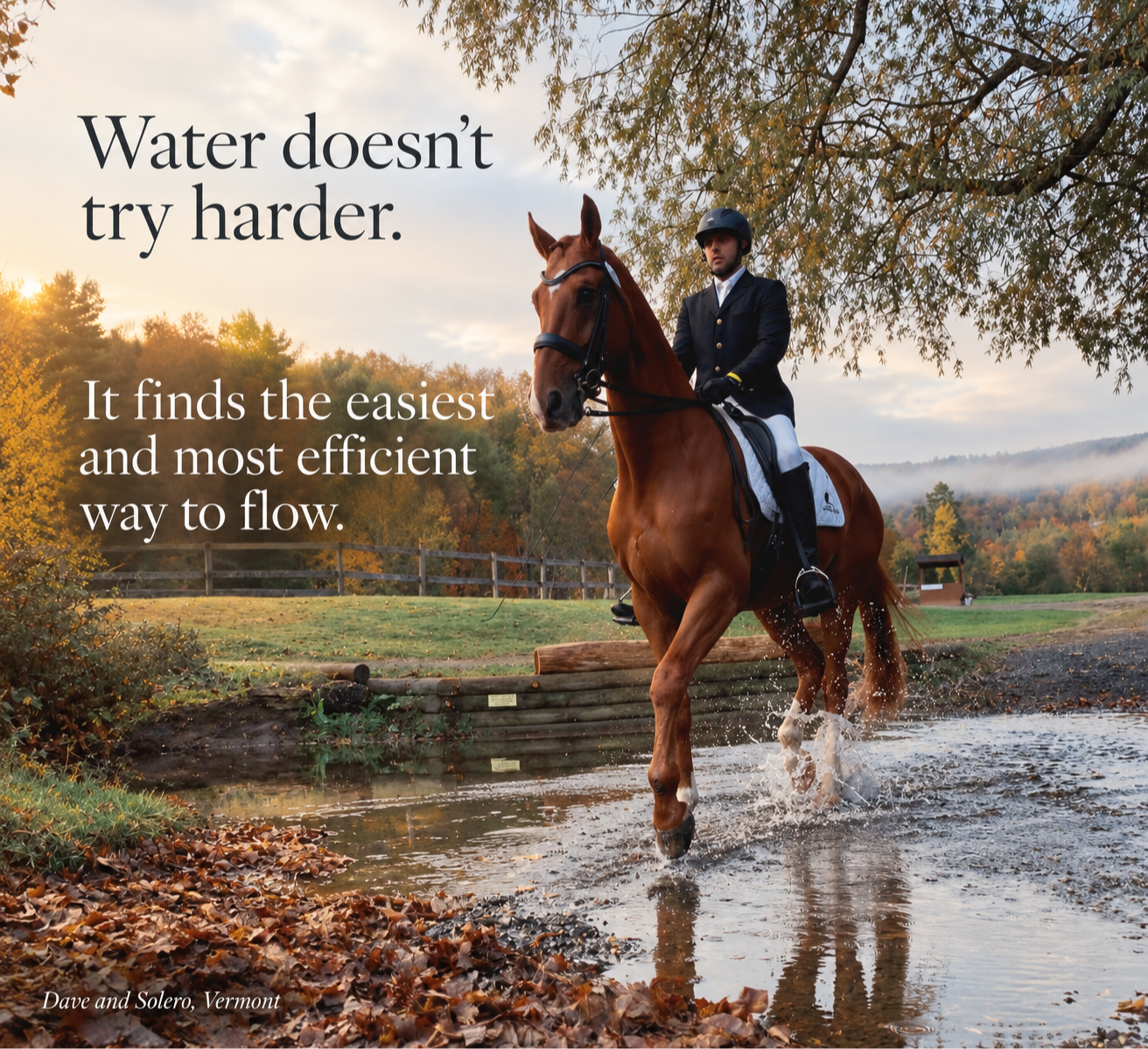
What If Easier Is Actually Better?
Dr. Moshe Feldenkrais said:
“The sensation of effort is due to other actions being enacted besides the one intended.”
Sometimes what feels difficult does not require more strength, repetition or determination.
Sometimes there is simply too much happening.
Too much gripping.
Too much bracing.
Too much unnecessary muscle contraction.
Too much effort spent holding up a posture artificially.
What becomes possible when your nervous system learns what it no longer needs to do?
Not less involvement.
Not collapsing.
Not becoming passive.
But using the right amount of effort, in the right place, at the right time.


Meet Dave: Your Trusted Instructor on the Path to Masterful Riding
Dave, a lifelong equestrian and an expert in the Feldenkrais Method®, knows firsthand the struggles dressage riders face. From major injuries to frustrating stiffness, he's experienced it all and emerged stronger, thanks to his application of the Feldenkrais Method®.
With years in the horse world, each endeavor he took has been an incredible learning experience. Dave understands your challenges and dreams like no one else.
His passion? Sharing this transformative method with riders across the globe.
Whether you're battling discomfort or aiming for the next level of performance, he's dedicated to helping you achieve your dressage goals and transform your riding experience.
Meet Dave's Mom
Sometimes the clearest proof of a method shows up in the most ordinary moments.
Recently, my mother was dealing with a severe flare-up of back pain. She broke her back a few years ago, and there was talk years ago of surgery to address neck issues. She therefore had every reason to believe pain was simply something she had to endure: an old spinal injury, arthritis, age, and years of familiar discomfort.
Her default response was the one many of us know:
Take something for the pain. Push through. Endure it.
Instead, I guided her through about three minutes of very gentle Awareness Through Movement®.
At first, she was moving with far more effort than necessary.
I gently pointed that out and softly said:
“You’re yelling with your movements. I want to invite you to learn how to whisper them.”
Smaller.
Softer.
Almost effortless.
More like listening than exercising.
Within a few minutes, something changed. Her movement became easier, and in that moment she reported that the pain had disappeared.
What fascinated me most was not just the relief.
It was her confusion.
Even though she has previously experienced many aha moments with Feldenkrais, she was amazed. She thought improvement should have required something harder — stretching, effort, sweating, struggle. Or just more effort?
But Feldenkrais often works in exactly the opposite direction.
Less effort. More information. More choice.
That is one of the reasons I am so passionate about this work.
And it is the same principle I bring to riders — whether I am working with an Olympian, an adult amateur, or my own mother.